August Schell was born in Germany’s Black Forest region in 1828. After studying to be a machinist, he immigrated to the U.S. in 1848—traveling to New Orleans by a steamer ship before stopping in Cincinnati, where he found work at the Cincinnati Locomotive Works, as well as his future wife, Theresa Hermann. They married in 1853, before leaving Cincinnati with their two young children in 1856 as part of a contingent from the Turner Colonization Society of Cincinnati, traveling by river boat to see what lay further west. Led by Wilhelm Pfaender, their group founded New Ulm in 1857, with August finding work in a flour mill.
That didn’t last long. In 1860, August partnered up with Jacob Bernhardt, who had served as brewmaster at Benzberg Brewery (later to become Minnesota Brewing Company…), and the two built a small brewery nearby right along the Cottonwood River, producing about 200 barrels of beer annually. The new brewery grew steadily over the years, and the Schells would build a mansion on the brewery grounds in 1885, complete with elaborate gardens and a deer park—all currently still around and listed in the National Register of Historic Sites. August’s arthritis would eventually have him back off of daily operations, with his sons stepping in to manage things. After August passed away in 1891, his son Otto led the brewery forward.
Over the years, the extended Schell family would expand the brewery, upgrading and buying new equipment, including refrigeration. Up until 1900, its brewing calendar was determined by the weather, with ice being collected from the Cottonwood River and stored inside caves under the brewery, controlling the fermentation temps, until the ice melted. As Prohibition served to bring down a majority of breweries in the early half of the century, August Schell’s Brewing Company survived by transitioning their production line to making near beer (0.5% or so ABV), soft drinks, and candy. They kept a secret basement brewery for their workers.
The brewery survived many more challenges to follow, including a glut of new breweries in the 1970s and financial struggles in their myriad forms, but remained aloft and was the first brewery in Minnesota to produce craft beers in the 1980s, with German-style craft lagers. A wheat beer was added in 1984 (“the first wheat beer after Prohibition”), and by 1990 there were 38 different beers being produced by the brewery. A new state-of-the-art brewhouse was added in 1999, the classic Grain Belt brand was purchased and kept alive in 2002 (after Minnesota Brewing Co. went bankrupt), and a new gift shop and taproom were added in 2005. All throughout the years, the brewery continued to adapt to the changing beer scene.
In 2012—and particularly key for one of this month’s featured beers—Schell’s began their Noble Star Collection, a series of beers inspired by German Berliner Weisse. Cypress wood from brewery tanks dating back to 1936 were repurposed for the project, providing porous material that was perfect for brewing this style of beer, and these tanks are used for each of the beers in the Noble Star line, starting with Star of the North in 2013. Starkeller, Schell’s sour-beer-dedicated facility, opened its taproom to the public in 2017, allowing visitors to enjoy these German-style tart beers right next to the ancient cypress tanks they’re aged in.
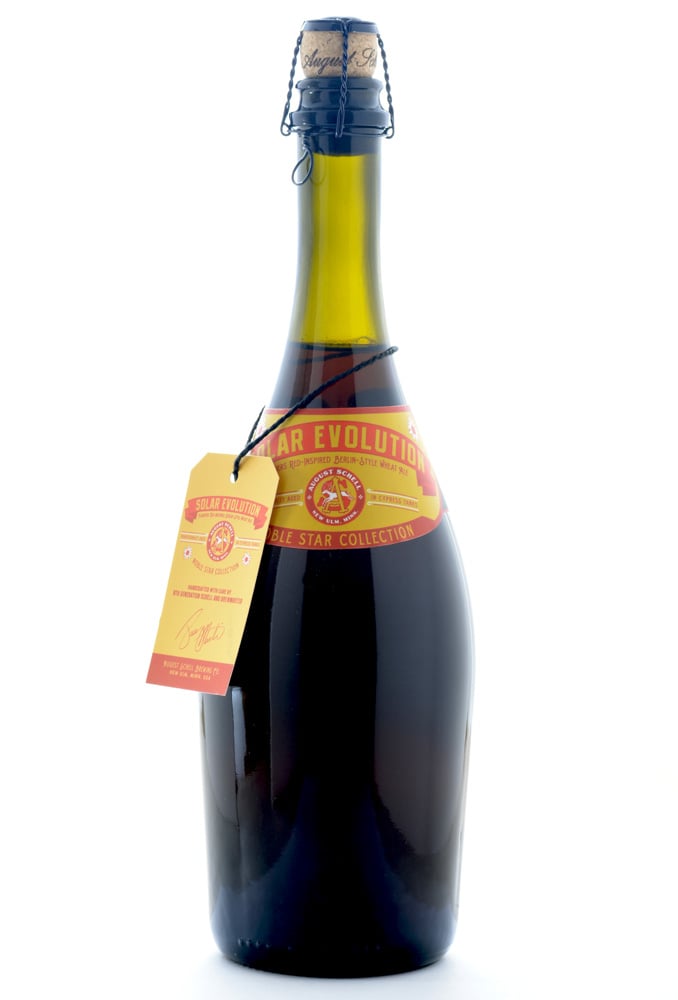
This month we’re pleased to feature our favorite release to date from August Schell’s Noble Star Collection—the Flanders-red-inspired Solar Evolution. For those looking for a bit more history, learn more about this 150+-year-old brewery at www.schellsbrewery.com.