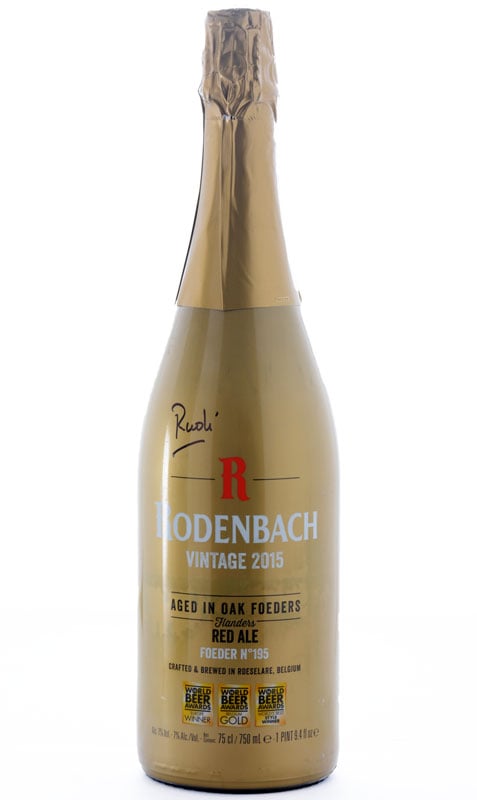
There is perhaps no more famous brewery in all Belgium than Brouwerij Rodenbach. While the country has a long history of brewing both tart and downright sour beers using wild yeast and bacteria, it was Rodenbach in the late 19th century that helped pioneer and define the specific style of beer we know as Flanders Red Ale, considered by many to be the most vinous, or wine-like, of all beer styles. The standard Rodenbach is a blend of approximately 75% fresh and 25% 2-year aged ale, while Rodenbach Grand Cru incorporates much more aged beer (approx. 66%). Their Caractère Rouge starts as 100% 2-year-aged ale, which then undergoes a 6-month maceration with fresh cherries, raspberries, and cranberries.
We’ve been able to secure Rodenbach’s Grand Cru and Caractère Rouge in previous years, and this month we’re thrilled to bring their stellar Vintage 2016, one of the brewery’s most exceptional (and limited) offerings—with at least one bottle in each Rare Beer Club shipment signed by Rodenbach’s brewmaster Rudi Ghequire.
In 1878, Pedro’s grandson Eugène became manager of the family brewery. From a brewing perspective, as opposed to a political one, Eugène is certainly the most influential Rodenbach in the family line. During his travels to southern England, he was exposed to, and learned much about, the early porter beers popular in London at the time. In the 19th century, these early porters were typically aged for at least several months in giant barrels where they matured and acidified. Eugène took what he learned and applied it at home in Belgium, developing and refining the technique, and creating the style of Rodenbach beers we know today.
Rodenbach’s red ales undergo a primary and a secondary fermentation, with both yeast and lactobacillus bacteria, creating beer with distinct acidity and tartness. The beer is then aged and matured in huge oak barrels known as “foeders” in Flemish (“foudres” in French), some of which are older than 150 years. Of these impressive foeders, Rare Beer Club founder Michael Jackson once wrote, “Rodenbach, in Roeselare, has ten or eleven halls full of these tuns. There is nothing comparable in any brewery elsewhere in the world, and the whole establishment is a temple of industrial archaeology.”